“Fake it till you make it.”
This is often the first quote that comes to mind when thinking about confidence. While it has its merits, my life experiences have taught me that confidence isn’t about pretending—it’s about embracing the possibility of failure. True confidence is being comfortable with falling, knowing that each stumble teaches us how to stand stronger.
It takes courage to make mistakes and even more to console ourselves when guilt sets in. But learning to accept yourself, flaws and all, is one of life’s most important lessons. Life, after all, is a chaotic dance—a rhythm of emotions, phases, and yes, mistakes. But isn’t that imperfection part of its beauty? Confidence, at its core, is a form of authenticity, a willingness to be yourself unapologetically.
“To succeed in life, you need two things: ignorance and confidence.”
— Mark Twain
“You don’t have to change who you are; you have to become more of who you are.”
— Sally Hogshead
Authenticity Is Your Power
It’s easy to fall into the trap of comparison, thinking, What I’ve done has already been done—and better! But that’s the wrong lens. No one else has your unique perspective or voice. As the saying goes:
“No one is you, and that’s your power.”
Authenticity isn’t just a form of confidence—it’s the most enduring kind. When you accept yourself, you radiate reliability. This is why confident people, especially leaders, inspire trust. They remind us of the power in clarity, decisiveness, and integrity.
“A true leader has the confidence to stand alone, the courage to make tough decisions, and the compassion to listen to the needs of others. He does not set out to be a leader but becomes one by the integrity of his intent.”
— Douglas MacArthur
Understanding Confidence Through Learning
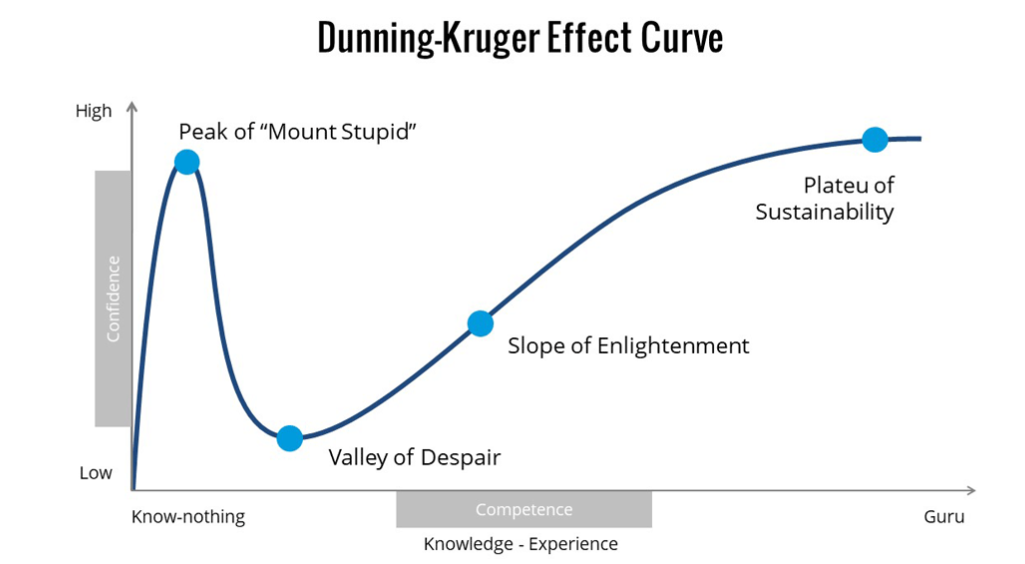
Confidence isn’t static; it evolves as we grow in any field. To understand this, let’s look at the Dunning-Kruger Effect, which highlights how our confidence levels change as we learn.
- The Beginner’s Overconfidence: At the start, we often overestimate our abilities, fueled by enthusiasm but lacking depth.
- The Valley of Despair: As we learn more, our confidence dips—we realize how much we don’t know. This is where doubt creeps in, asking, What if I fail? What if I’m not good enough?
- The Plateau of Sustainability: Persistence leads to growth, where our confidence aligns with our skillset. This balance is the hallmark of mastery.
The journey can feel like a rollercoaster, but the key is to keep going. Even when motivation wanes, action keeps the momentum alive. Confidence is not a prerequisite for progress—it’s a result of consistent effort.
Dealing With the “What Ifs”
Doubts like What if I fail? or What if this isn’t my path? are natural companions to ambition. Instead of resisting them, acknowledge their presence without giving them control. Remember:
“The fear of failure is often dwarfed by the regret of never trying.”
Doubts are signs you’re stepping out of your comfort zone—the very space where growth happens. Let them guide you, not stop you.
Practical Steps to Build Confidence
For those starting their journey or grappling with self-doubt, here’s how to take actionable steps:
- Start Small: Focus on achievable tasks to build momentum. Every small win reinforces your belief in yourself.
- Embrace Mistakes: Shift your mindset to view failures as stepping stones rather than setbacks.
- Reflect Regularly: Celebrate progress, no matter how small. Reflection reminds you of how far you’ve come.
- Seek Support: Surround yourself with mentors, peers, or communities who inspire and encourage you.
- Practice Self-Compassion: Be kind to yourself, especially when things don’t go as planned. Confidence grows in an environment of acceptance.
The Art of Confidence
Confidence isn’t about perfection or a linear path to success. It’s about embracing the chaos of life—the stumbles, the doubts, and the breakthroughs. Life, as I see it, is a form of art. And confidence? That’s the bold stroke of authenticity that makes the masterpiece uniquely yours.
So the next time you feel uncertain or unworthy, remind yourself: No one is you, and that’s your power. Take a step forward, however small, and trust that each step adds to the rhythm of your journey.
“You don’t need to have it all figured out to start. Confidence grows as you go—one step, one action, one moment at a time.”
Tags: #philosophy #self-talk